The Cook

He fed my grandmother, he fed my grandfather; he fed my mother and he fed my father; he fed my brother and me. When we left the country, he went back to feeding my grandmother.
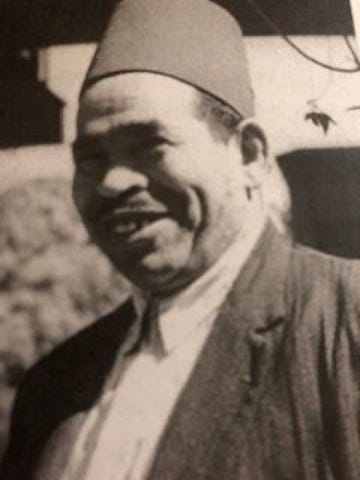
He fed and served three generations with a certain quiet pride, and, I like to think, with some affection also. In the day and age in which he lived, from the twilight of Ottoman Egypt, to the reign of King Farouk, and into the subsequent overthrow of the monarchy and the days of Nasserite rule, he was considered a little man: a lowly cook, the servant class. Yet, he looms large in my memory, his rotund body, clad in a "galabiya", an ankle-length gown, typical in Arab countries, his spherical head, topped with the dignified burgundy tarboosh or Fez as it is better known in the west, with its silky black tassel. Daily he would arrive at the house, at about 11:00 a.m., laden with his canvas bag, filled with the purchases needed for the preparation of the days midday meal, the main meal of the day.
A modest and painfully shy man, he spoke sparingly and quietly. My conversations with him consisted of complimenting him for a particularly delectable dish he had prepared, or requesting a favourite dish, or asking whether he had any food for the numerous cats that hung around the kitchen door; I recall counting about 10 cats at one time. He went about his work with a very earnest expression on his face, but when he smiled, it was joy and sincerity that beamed across his face. The dishes he prepared were perfect in every aspect and I am sure he prepared them as they were intended by their inventors.
As a newly married bride, my grandmother was looking around for a cook to engage for her household. She was referred to an aristocratic household, in whose kitchen worked a reputedly talented young apprentice, and that is how Osta Mohamad came to join our family. Osta meaning Master. For three generations he was as reliable as the muezzin's calls to prayer. He represented a lifestyle of constancy, regularity and stability.
On a visit back, I intended to visit Osta Mohamad in his home which was located in an old quarter of Cairo, known as Ibn Touloun, named after Cairo’s largest and oldest mosque, still in its original form, built between 876 and 879, by Ahmed Ibn Touloun. I was looking forward to seeing his beaming smile and I hoped to somehow convey the affection he had nurtured in me. I picked up the telephone and dialled the number of an old family friend who had been tasked to pay his monthly pension and who was to lead me to his place. I quickly learned that Osta Mohamad was no more - he was feeding the worms. He had passed away two weeks before. I was stunned and felt quite abandoned in the great city of Cairo. Another thread which bound me to her, had been severed.
Now, when I prepare the rice and concentrate hard on trying to make it "mefalfel", light and fluffy, with all the grains firm and separate, or when I make the "taqlia", frying the garlic and coriander seeds to release the aroma, for the Molokhia, Egypt's national dish, I realize that Osta Mohamad still lives, and continues to feed me, my husband and our daughter, here, faraway, on the other side of the world.
À heartfelt and beautifully written portrait. You’ve come a very long way from the McGill days! Congratulations!
Nesrin, your story resonated for me, when you wrote about how you lost a connection with your country when he died. I feel the same about Italy. As you said, when you cook the food, it feels like they're still feeding you. Great story.